Start with permission
Most ditches and laterals in the middle Rio Grande valley are part of an irrigation system run by a district — commonly the Middle Rio Grande Conservancy District — or by a local acequia association. Installing, replacing or changing a crossing usually needs their okay, and they may have rules on pipe type, size and timing (often outside irrigation season). Check first; it's much easier than redoing a crossing later.
Why crossings fail
- Pipe too small — water backs up, overtops the crossing and erodes it.
- Fill not compacted — it settles around the pipe and the driveway dips.
- Shallow cover — the pipe crushes under trucks.
- Unprotected ends — water cuts around the pipe.
A crossing built right
- Approval from the ditch owner, with any requirements in hand
- Pipe sized for the flow, set on a firm, even bed
- Backfill placed and compacted in thin layers on both sides
- Enough cover over the pipe for the vehicles using it
- Rock or headwalls at the ends
- Base and asphalt (or chip seal) over the top
Storm runoff crossings
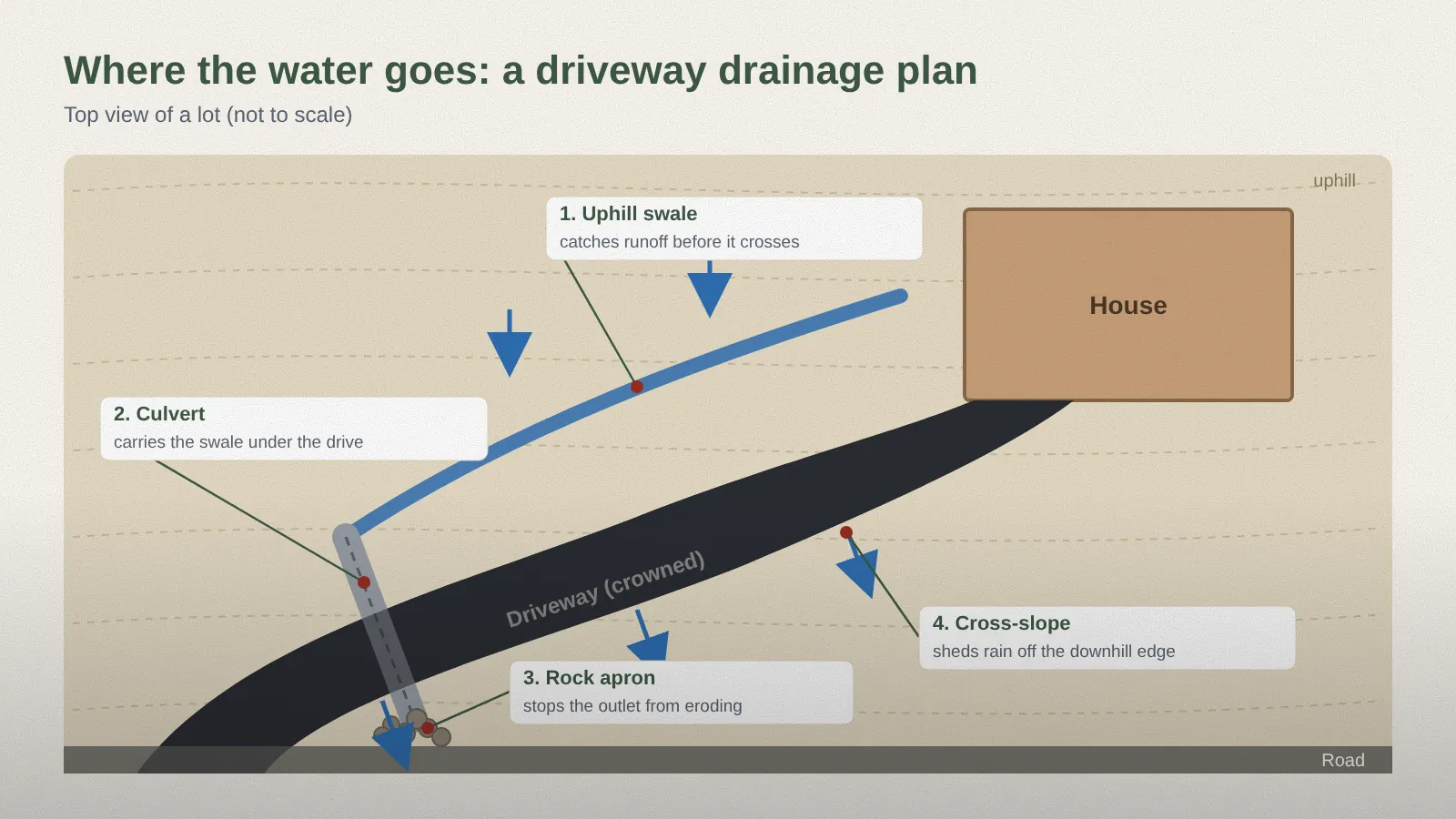
On the mesas the "ditch" is often a natural drainage path that only runs in storms. Same principles: size the pipe or build a dip, and protect the outlet.
See our ditch crossing service for how we handle the work.
Common questions
Can I just put a pipe in the ditch myself?
Check with the ditch owner first — unapproved crossings can be ordered removed.
Why is my driveway sinking over the ditch?
Almost always uncompacted fill around the pipe.
When can crossings be built?
Often outside irrigation season. The district can tell you.